Showing posts with label 2012. Show all posts

Thursday, April 17, 2014

The Hunt (2012)

Poster thanks to Impawards.com

The Hunt is a film directed by Danish filmmaker Thomas Vinterberg, starring Mads Mikklesen. This is Vinterberg's most recognized film, as it was nominated for the 2014 Academy Awards for Best Foreign Language Film. Mads Mikklesen is a more prominent name in film, especially with his recent stint as Dr. Hannibal Lecter in NBC's Hannibal. Without spoiling the ending, the film is about a nursery school teacher, Lucas (played by Mikklesen), attempting to win custody of his son after a bad divorce. This dream is shattered when he is wrongfully accused of sexually assaulting a little girl. 

I personally have a difficult watching films with sensitive topics, such as this. It isn't just that I feel uncomfortable watching such subjects, but that the film literally makes my skin crawl while watching. Topics such as the holocaust also cause a similar reaction. As such, I tend to avoid films like this entirely. Somehow I was pulled into watching The Hunt. At the close of the film, I was glad I had made it through, and even suggest this movie to viewers in the future. At the start of the film, however, I almost found myself walking away. My anxiety became so great that I, and I sorrowfully admit this, looked up the summary so that I could know the ending before I continued watching. I'm not sure what drove me to do this, but what I read helped me stay in my seat, and even though I spoiled myself, I find that the experience of watching the movie became better for me. 

Mikklesen's performance was incredibly believable and transcended expectation. Thomas Bo Larson, who played Theo, Lucas' best friend, was also outstanding. His performance put his name on the map for me, and I hope to see his future work. These great and established actors aside, I believe the entire show was stolen by Annikka Wedderkopp, who played kindergardener Klara. Not much can be found about Wedderkopp on the internet, although from the film it can be gathered that she is very young indeed. Her youthfulness does not at all hinder the immense performance she gave. As a passionate filmmaker myself, I would love to talk to director Vinterberg to see just how he got such a performance. It is always astounding when child actors walk before a camera and give an explosive performance. Although it can never truly be determined if a child will last long in the industry, I certainly hope to see Wedderkopp resurface.

For me, The Hunt was a film more about character building than about anything else. The semi-soul crushing plot aided the characters changes throughout, and even brought characteristics to light that had otherwise been ignored and laying dormant. I suggest this film to anyone who wants to see incredible acting at the forefront of a movie. B. 

Monday, November 12, 2012

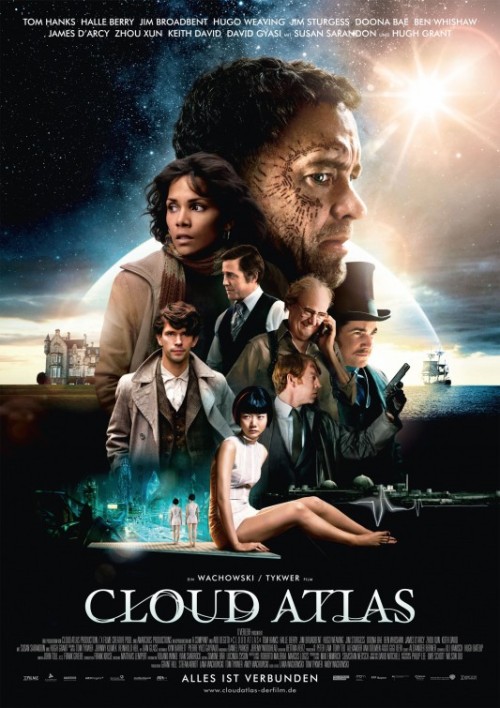
Cloud Atlas (2012)

Poster byWORKS ADV
"Cloud Atlas" is a science fiction film directed by Lana and Andy Wachowskis and Tom Tykwer. The film takes places over generations and ages and realities and dreams and fantasies. The film stars Tom Hanks, Halle Berry, Ben Whishaw, and Xun Zhou.

"Cloud Atlas" does not follow a linear story line in that it recounts the tale of a main character in straightforward fashion. Instead it cuts back and forth between characters and these characters individual tales. The film has many main characters across various eras and times. The stories of these characters at first seem to be standalone stories, but by the end of the film it becomes apparent that all the stories are somehow connected in one way or another. Something interesting about the film: the actors did not only play one role, but played many roles over all the different narratives.

What I found most intriguing about this film was it's use of storytelling. Each character passed through their story as if they singlehandedly controlled their own destiny. As the narrative progressed, however, it became apparent to the viewer, as well as the character, how very untrue this mentality was. The characters were no more in control of their own life as they could be in control of another humans life. The film was more about the codependency of a race, of a group of people, of a couple than anything else. It became clear that each character and their existence was only made possible by the reliance on others. The message of the film, often repeated by the characters across story lines, was that everyone is connected. Characters who lived in a Neo Soeul in 2114 were dependent on those characters who lived in Victorian England, and so on and so forth.

If I were to have a complaint about this film, however, it would be directly related to one of the story lines followed. Tom Hanks and Halle Berry both star in in one tale titled "The Hawaiian Islands on post apocalyptic earth (dated 2321)." My largest complaint was primarily the dialogue and how it was spoken. The lines given to the actors was written in a severe reconstruction of the English language, a new vernacular of sorts for those on earth who survived the apocalypse. Whenever this story was on screen, I had a hard time paying attention due to the fact that I couldn't understand a word that was being spoken. This drew me out of the film experience, which is one of my greatest pet peeves. If it were to eliminate this story entirely from the film, I would have had a much more pleasant time watching the film.

I enjoyed "Cloud Atlas" overall. I found it entertaining, and at some parts even moving. I will rate it a C+ only because at times I felt the message of the film was being continuously repeated as if I was unable to understand it. I also thought "Cloud Atlas" was trying to desperately to be what "Tree of Life" (directed by Terrence Malick) was two summers ago.

Monday, October 22, 2012

2012 Film Challenge

This post isn't going to be a movie review this week. Sorry folks! I had a very interesting experience that I felt would be relevant to share in place of a review.


This weekend I participated in a 48 Hour Film Challenge. The basis of this challenge was to write, shoot, and edit a film within 48 hours. The only catch is that you don't know what film you will be shooting until 7:00 pm on the first day. The challenge gives each team a genre, line of dialogue, prop, and character, and each team must incorporate those elements into their film in order to be qualified.

This isn't my first time participating in a 48 Hour Film Challenge. I, along with three other teammates, participated in the New Haven festival over the summer. Unfortunately we didn't submit our film on time and were subsequently disqualified. This time around, however, went much more smoothly.

My team name was Lemon Difficult, and I had the pleasure of working with Matt Lumas, Matt Scripter, Nicole Caputo, Marc Womp, Joe Brown, Paul Kazmierski, Caitlin Read, and Albert Prempeh. Our elements are as follows:
Genre: Western,  Prop: Skeleton Key, Character: Cassidy Denver, drummer, Line of Dialogue: "And that's how I learned..."
Friday Oct. 19 we received our elements and began brainstorming. We finished our script around 9 pm and began storyboarding. By midnight our story and shots were hammered out and we were ready for a day full of shooting. We had a call time of 8:30 am Saturday, at which all of the cast and crew transferred all of the equipment to our location and set up. By 11:30 am we were film, and by 4 pm we call it a wrap. We spent the rest of the day editing and didn't finish editing until 11 pm on Sunday.

Out of a hectic 48 hours came "No Better Justice." I am very pleased with the final product. I am especially pleased considering it was my first time directing a crew for a creative piece, so I was glad to expand my boundaries and pick up some experience. I also got to try my hand at a little editing, although the bulk of the editing was left to the very talked Matt Scripter.

Above I posted the video to our film. Feel free to give it a watch and don't hesitate to let me know what you think!

Monday, October 15, 2012

Argo (2012)

Photo courtesy of mubi.com
Argo is a film directed by and staring Ben Affleck. It is Affleck's third feature length release, following the highly successful The Town, which came out in 2010. As soon as I saw a trailer for this film, I knew I was interested in seeing it. Affleck has been praised for his ability to make engaging and commercially successful movies. The film also stars Bryan Cranston and John Goodman.

The film follows the Iranian Hostage Crisis which happened from 1979-1981. It does not follow the 54 Americans that were held hostage, however, but the 6 American's that managed to flee during the storming of the American Embassy. It follows their stay at the Canadian ambassador's house and the CIA mission fronted by CIA operative Tony Mendez that resulted in their rescue. The operation that saved the Americans followed Mendez's idea that the American's and himself would pose as a Canadian film crew in Iran to scout locations for an exotic science fiction thriller. Mendez arrived in Iran and gave the American's all new identities that they would need to memorize overnight. At first they were skeptical of this mission, unsure if trusting Mendez would result in their rescue, or their capture.

All in all, the film was entirely gripping. For it's duration, I found that I was on the edge of my seat and unable to contain my anxiety. A lot of the films greatness came from it's ability to hold the audience in the palm of it's hand. Through the use of shallow focus and the gradual change from long shot to extreme close up, and occasionally the drastic juxtaposition of long shot and close up, added to it's thrilling nature. I never once found my mind drifting to another another topic. The film is exactly 2 hours in length, but the pacing was genius in that I thought I had only been watching the screen for an hour.

Argo has very positive prospects for being nominated during the upcoming award season. The acting credentials were massively impressive, however I find it difficult to believe that any of the actors will receive nominations, especially with the minimal screen time given to any of the actors. The main focus of the film was the rescue of the Americans, instead of any exploration of any character strange.

I suggest this film to anyone who loves fast paced and thrilling adventures. Also anyone who is mildly interested in history. I give this film a B+.

Monday, October 1, 2012

Lawless (2012)


Lawless is a film directed by John Hillcoat. I viewed this film a couple weeks ago at Criterion Cinema located in Downtown New Haven, which, as a side note, is my favorite of all theaters in the greater New Haven area. The film is based on the true story of the Bondurant brothers and their exploits as bootleggers of moonshine during the Great Depression. The film stars Tom Hardy, Shia LaBeouf, Guy Pearce, Jessica Chastain, and Gary Oldman.

I was skeptical when going into this film, having followed its progress through pre-prodution, filming, and post-production. It had many reshoots and renamings, all clues to the instability of the production process, which lead me to question its merit as a film. Once the trailer was released, my fears were confirmed. A once interesting concept had probably been shaped into a flimsy Hollywood action release. The cinematic merit that had shone during its early days had obviously been lost under the corporate hands of The Weinstein Company, the films distributor.

All in all, the film was a major disappointment. Not even halfway through, I felt myself huffing and puffing at the overly genre-likened writing and bland cinematography. I could not find anything remotely unique about this gangster era gunslinging movie. It could not come close to competing with the likeness of Bonnie and Clyde (1967), a film that took the gangster genre to a level not yet explored. Bonnie and Clyde added a depth and motivation into their characters, where as the writing in Lawless striped the characters of any true meaning, and placed all motivations under sexual desire without allowing for any explanation.

My largest complaint, however, was the over sexualization of the female characters. The Bondurant brothers essentially used their bootlegging business as a means to acquire the female body, and because of this, the women of the film were automatically subjugated to only live in the eye of desire. An example of this is when Shia LaBeouf's character wishes to join in with his brothers and become a successful member of the Bondurant team. He makes it a point to become the most successful and flashy member of the family through the purchasing of new stylish clothes and high end cars. He does this only to impress a lowly amish girl who has caught his eye. He does not actually care for the business of bootlegging, only the business of watching the amish girl remove her clothes. Mia Wasikowska, who plays the amish girl, is over sexualized throughout the duration of the film because she is seen through the horny eye of LaBeouf's character. The way this is done is through the "peeper technique," in which the camera stealthily hides itself from the person being captured. In various scenes, she is caught in compromising positions due to this technique. Also, instead of focusing entirely on her face during important scenes between LaBeouf and her, the camera instead hovers over the curve of her collar bones or focuses directly on her moving lips. She is no longer a woman, but an object reduced to the sensual portions of her body.

I would not suggest this movie to anyone who does not want to waste their time. However, if you are looking for a fast passed and meaningless action film, please be my guest.

Sunday, September 23, 2012

The Master (2012)

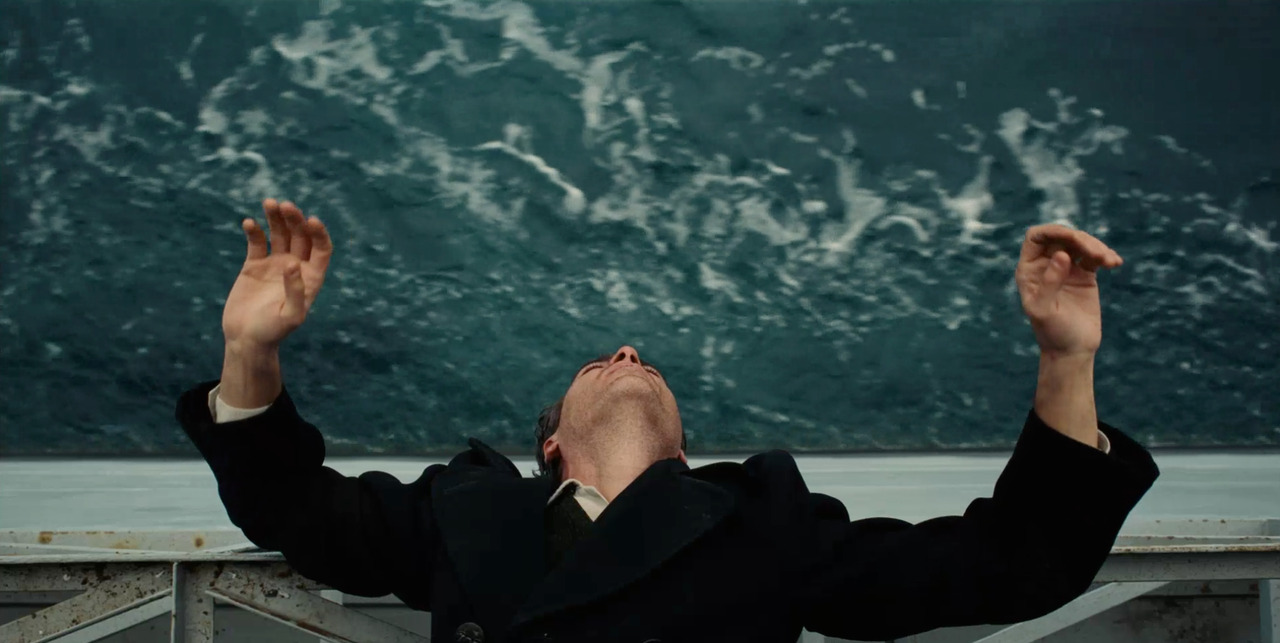
Photo from film's trailer
This weekend I had the pleasure of viewing Paul Thomas Anderson's most recent feature length release titled The Master. Anderson in most known for his 2007 film titled There Will Be Blood which stars Daniel Day-Lewis. Because There Will Be Blood is regarded by many critics as one of the best films of the last decade, the release of The Master was highly anticipated.

The film follows a disenchanted WW2 veteran named Freddie Quell, portrayed by Joaquin Phoenix, as he drifts from place to place in the troubling period after the end of the war. He eventually finds his way onto a cruise vessel belonging to a Lancaster Dodd, played by Phillip Seymour Hoffman, the leader of a strange new religion calling itself The Cause. Dodd, noticing the restless and uncontrollable nature of Quell takes the young man under his wing and calls him his protege. The rest of the film follows the budding relationship between Quell and Dodd, and their experiences with the ever growing notoriousness of The Cause.

At the end of the film I was left wondering "What was the point?" I wondered what questions Anderson had posed for the viewer and whether or not they had been answered. I then realized that from the start there may not have been direct questions asked, but rather themes placed strategically for the viewer to find. 

One of the themes, and in my opinion the most important, revolved entirely around Freddie and his desires, mainly sexual desires. Although it is never implicitly stated why Freddie does what he does, it can be gathered through cinematic elements just how sexually deprived Freddie is and how this dictates his every decision. One scene in particular is about halfway through the film in which Dodd and his followers are having a party. Dodd takes in into his own hands to dance and sing around the room. The camera at first focuses mainly on Dodd and his endeavors as an entertainer. It then cuts to a close up of Freddie as he gazes lustfully past the camera. It then cuts back to the exact shot of Dodd dancing and singing around the room, but this time all the females that had been previously clothed were now entirely naked. This shows that the eye of the camera is actually the lustful eye of Freddie. The camera can no longer be a trusted viewfinder. The viewer is no longer watching a story unfold from the outside of a fishbowl, but rather under Freddie's biased, sexual perception.

Another example of this theme, and perhaps the most telling, happens later on in the film. Dodd, Quell, Dodd's daughter and her husband head out into an unnamed desert. It is here that Dodd invents a game called "Pick a Point" in which you ride on a motorcycle as fast as you can towards the point you picked on the horizon. Dodd goes first, speeding off into the distance in unmatchable bliss. This camera follows him in a profile medium shot before switching to an extreme close up of Dodd's ecstatic face. The next shot is a wide shot of Dodd riding back towards his companions. When it is Freddie's turn to ride the bike, the camera follows him just as it followed Dodd in a profile medium shot. It then cuts to a wide shot of the motorcycle as it speeds further and further away from the camera. The next time the viewer sees Quell is as he walks up the steps of the house belonging to Doris, the woman he calls the love of his life. Freddie's desire to see his sweetheart is much greater than returning on the motorcycle to Dodd, the man who has become his father figure. His overwhelming need to be loved in a sexual way propels his decisions, and propels him away from the safety provided to him by The Cause.

It has been said that The Master is a criticism on the infamous religion of Scientology. The film does shed a negative light on Dodd's Cause, and there are many similarities between it and Scientology, but it never implicitly connects itself to Scientology, which leads me to believe that perhaps this is not the main thing Anderson was trying to convey. Instead, I believe Anderson was focused on intimate character studies and exploration of themes, such as sexual desire. As an overall film, The Master can at times be static, but I find that this is intentional and has a pleasing effect. Anderson's use of extreme close ups juxtaposed with wide shots gives the viewer a feeling of unease coupled with claustrophobia. As a viewer, we are intruding on these intimate experiences and displays of lust, and then forced to come to terms with them when thrown into extreme wide shots.

As an overall film, I would say The Master is an accomplishment for Anderson. I certainly enjoyed it much more than his previous effort of There Will Be Blood. My rating as of right now is an A- and I recommend everyone to go and see it.